


Share This Article
There’s a particular kind of confidence required to make an album like Melodi. Not the confidence of maximalism or technical exhibitionism, but the quieter certainty that atmosphere, memory and emotional pacing can still carry electronic music without needing to constantly announce their importance. In an era where dance records are increasingly engineered around immediacy — playlist compatibility, social media virality, peak-time functionality — Sommerfeldt delivers something refreshingly patient with his debut full-length release. Melodi is not interested in urgency. It unfolds slowly, almost geographically, like a travel diary reconstructed from fading recollections, half-remembered club nights and fragments of landscapes captured in motion.
That sense of movement is central to the album’s identity. Though rooted in Oslo, Melodi feels untethered from any singular location or scene. Across its six expansive compositions, Sommerfeldt constructs a sonic world informed as much by physical travel as by emotional drift. Ocean waves, bird calls and environmental textures recorded during years of movement across different countries become part of the album’s DNA, processed through hardware samplers and analogue synths before finally being assembled in his Grünerløkka studio. Yet Melodi never falls into the common pitfalls of “organic” electronic music. These field recordings are not decorative signifiers of authenticity. Instead, they function more subtly: ghostly presences embedded deep within the music’s architecture, giving the record an uncanny sense of lived space.
That spatial awareness perhaps comes naturally to an artist with over two decades immersed in electronic music culture. Sommerfeldt’s career trajectory — touching labels like Full Pupp, Paper Recordings and Badabing Diskos — reveals a producer who has always operated slightly outside strict genre orthodoxy. Melodi embraces that eclecticism fully. While the album’s foundation rests upon sturdy drum machine grooves and deep house propulsion, its emotional vocabulary stretches far wider: ambient music’s introspection, the romantic melancholy of new wave, Balearic looseness, traces of Italo shimmer and, perhaps most intriguingly, echoes of the downpitched progressive trance that defined sections of early-2000s European club culture.
That last influence proves particularly significant because it gives Melodi much of its emotional gravity. The album repeatedly recalls an era before electronic music became dominated by functional precision — when progressive dance music often prioritized storytelling, gradual immersion and emotional ambiguity over immediate payoff. There are moments throughout Melodi that evoke the faded glow of millennium-era compilations: long highway drives after illegal beach parties, overheated ferry cabins at sunrise, the lonely emotional afterimage of nights that felt culturally important at the time but now survive only as atmosphere. Sommerfeldt taps into that emotional register without resorting to retro fetishism. The references are present, but they’re refracted through maturity and distance rather than nostalgia.
What makes the album especially compelling is the way it balances cohesion with stylistic fluidity. On paper, Melodi’s ingredients risk sounding incompatible: ambient textures colliding with deep house rhythms, new wave romanticism brushing against trance melodrama, Balearic softness interrupted by gritty guitar passages. Yet the album never feels fragmented. Sommerfeldt understands sequencing and tonal continuity at a remarkably sophisticated level. Every transition feels natural, every stylistic detour emotionally justified. Tracks bleed into one another with an almost cinematic logic, creating the sensation of a single extended journey rather than six isolated productions.
A large part of that coherence comes from the album’s restraint. Despite its rich palette of influences, Melodi rarely feels overcrowded. Sommerfeldt consistently resists the temptation to push tracks toward obvious climax or excessive density. Instead, he allows arrangements room to breathe. Melodies arrive slowly and often dissolve before fully resolving, while percussion remains hypnotic rather than aggressive. The grooves themselves are deceptively simple — tightly programmed drum machine patterns that act less as dominant rhythmic statements and more as subtle frameworks supporting the album’s emotional movement.
The collaborative performances scattered throughout the record deepen that atmosphere considerably. Contributors like Embla Maria, Sigmund Floyd, Toshybot, Guro Kverndokk, Kristian Solhaug and Magnus JJ never feel like “features” in the contemporary streaming-era sense. No guest appearance arrives merely to diversify the playlist appeal. Instead, each contribution feels integrated into the album’s emotional ecosystem. Vocals drift through tracks like fading internal monologues rather than attention-demanding centrepieces, while guitars and percussive textures add grit and tactility to the otherwise dreamlike atmosphere.
There’s also an unmistakably Nordic quality running throughout the album, though not in the austere minimalist way often associated with Scandinavian electronic music. Melodi feels warmer than that. Even at its most melancholic, the record radiates softness — a kind of weathered emotional openness. The album’s relationship with melancholy is especially nuanced because it never collapses into despair. Instead, sadness and beauty coexist comfortably, much like they often do within Balearic music traditions. Sommerfeldt seems less interested in catharsis than in suspension: preserving emotional states rather than resolving them.
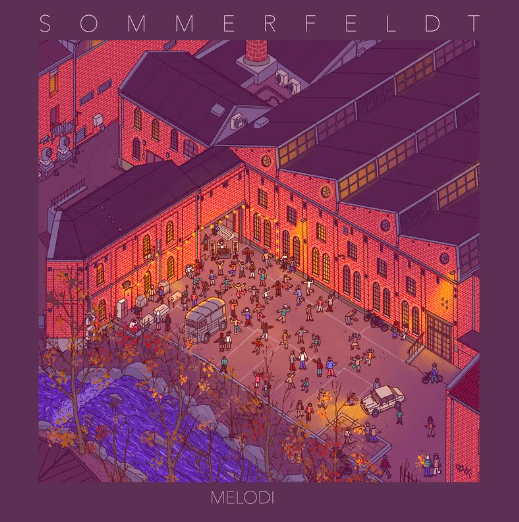
Visually, even the project’s physical presentation reinforces that philosophy. The bold orange vinyl edition scheduled for release in May 2026 feels appropriately tactile for music so obsessed with texture, memory and atmosphere. Likewise, the artwork by Quentin Desveaux complements the record’s aesthetic beautifully, extending its dreamlike ambiguity into visual form without over-explaining the music’s emotional intent.
What ultimately elevates Melodi beyond a well-crafted genre exercise is its understanding of time. This is an album shaped not only by four years of production, but by twenty years of listening, travelling, DJing and cultural accumulation. You can hear that lived experience in the record’s pacing and emotional intelligence. Nothing feels rushed. Nothing feels algorithmically optimized. The album trusts the listener to sit inside moods for extended periods rather than constantly demanding stimulation. In contemporary electronic music, that patience has become surprisingly rare.
There’s also something quietly radical about the album’s refusal to fully belong anywhere. Too melodic to sit comfortably within underground functionalism, too understated for mainstream dance circuits and too rhythmically driven to function purely as ambient listening, Melodi occupies an unusual liminal space. It’s club-adjacent music designed as much for solitary reflection as collective movement. The record seems to understand that electronic music’s emotional power often emerges outside the dancefloor itself — in transit, in memory, in exhaustion, in the strange psychological spaces between destinations.
For listeners raised on the emotionally rich progressive and Balearic cross-pollinations of the late ‘90s and early 2000s, Melodi will likely feel deeply familiar. But familiarity is not the same as nostalgia. Sommerfeldt is not attempting to recreate a lost era. Rather, he’s examining what remains emotionally valuable from those formative sounds and translating them into something personal, contemporary and deeply human.
By the time the album reaches its closing moments, Melodi feels less like a debut and more like the culmination of a long internal process finally given form. It’s immersive without becoming indulgent, emotionally resonant without sentimentality and stylistically expansive without losing focus. Most importantly, it possesses something increasingly difficult to manufacture in electronic music: sincerity.
In a musical landscape increasingly shaped by speed, visibility and disposability, Melodi chooses slowness, texture and emotional continuity instead. That decision alone makes it one of the more quietly affecting electronic albums of the year.
