


Share This Article
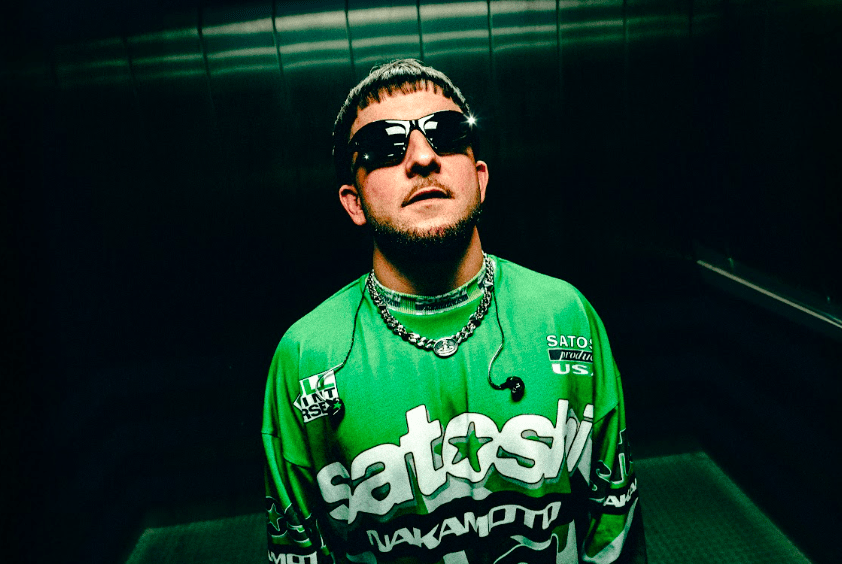
After fifteen years of moving between Dutch hip-hop, festival culture and his Polish roots, Mr. Polska is entering the harder electronic world without looking particularly interested in leaving his past behind. If anything, his move towards techno feels like a continuation of the same instinct that has shaped his career from the beginning: connect with a crowd, break down the distance between performer and audience, and make the show feel bigger than the music alone.
In the Netherlands, Mr. Polska is already part of a particular musical memory. His work with Nouveau Riche and a string of hugely successful tracks established him as one of the most distinctive figures of Dutch hip-hop in the early 2010s. Songs such as Hausa Wausa, Allermooiste Feestje, Zusje, Krokobil and Niemand became festival staples, while his career in Poland developed in parallel and introduced another side of the artist to a different audience.
That history is important because his current move into hard techno does not come out of nowhere.
The turning point was Polska Jumpstyle, his collaboration with Natte Visstick and Vieze Asbak. What started as a move into harder electronic territory quickly became something much bigger, eventually passing 42 million streams and finding support from artists including Sara Landry, FANTASM, Nico Moreno and Diplo. The track travelled far beyond the usual crossover audience and became part of the soundtrack of major techno and hard dance festivals, including Tomorrowland’s MainStage.
The releases that followed helped establish that this was not simply a one-off experiment. Mr. Polska had found a new environment for an energy that had always been central to his work.
Now he wants to take that energy to the stage in a different way.
Rather than becoming another DJ in an increasingly crowded hard-techno landscape, Mr. Polska is building a live show around the idea of the frontman. Live vocals, electronic music, performance and crowd interaction are intended to function as one experience, bringing some of the immediacy of a concert into a scene that is still largely built around DJ sets.
It is an interesting proposition because Mr. Polska already understands the role he is trying to fill. His entire career has been built around being visible, vocal and directly connected to an audience. He has spent years playing festivals and clubs where the crowd is not simply there to listen but to participate. The music may now be faster and considerably heavier, but the basic relationship remains familiar.
Early appearances at Teletech and Nachtwacht have offered a first glimpse of that approach. Even the now-famous image of Mr. Polska handing Polish pickles to people in the crowd between tracks says something about the project. It is playful, unpredictable and deliberately personal. Rather than adopting the serious, anonymous image often associated with techno, he is bringing his own character into the room and making it part of the performance.
That does not mean the music itself is secondary. The harder electronic material provides the physical foundation of the show: speed, pressure and the kind of energy designed for large-scale rave environments. But the purpose is different from a conventional DJ set. The tracks create the momentum while Mr. Polska stands in the middle of it, building tension and responding to the room.
His own description of the project captures the idea neatly. He does not want to be the next DJ, nor the rapper who turns up at a festival to perform a handful of songs. He wants to create the energy of a techno set with the impact of a frontman.
That ambition also explains why the partnership with Odysseys feels significant. Following a sold-out Dutch club tour and appearances at Teletech, Nachtwacht and Zwarte Cross, the project is now moving towards international stages, with upcoming performances including DURO in Spain and further dates across the hard techno and hard dance circuit.
The most convincing thing about this new chapter is that it does not require Mr. Polska to become somebody else. Born in Poland, raised in the Netherlands and established through Dutch hip-hop before finding a new audience in Polish music, he has always existed between scenes. Rap, rave and electronic music have never been completely separate worlds in his career.
The techno chapter simply gives that instinct a new setting.
In a scene where the DJ remains the traditional centre of attention, Mr. Polska is making a case for something different: an artist who does not simply provide the soundtrack to the rave, but steps into the middle of it and takes responsibility for the energy of the room.
Fifteen years into his career, the next chapter is not about starting again.
It is about putting the frontman where he believes he belongs — right in the middle of the rave.
Photo credit: Michelle Zwinkels
